On October 10, Stephen Wheatcroft, Professor of the School of Historical Studies at the University of Melbourne delivered a lecture on ‘The importance of the grain problem in the Russian Revolution and for the next 40 years of Soviet Economics' at HSE Moscow as part of a long and busy schedule. A participant at previous April Conferences at HSE, Professor Wheatcroft is one of the world’s foremost experts on Soviet social, economic and demographic history, as well as famine and food supply problems in modern world history.
On May 31, Valerie Kivelson, Professor of History at the University of Michigan, will be delivering a seminar entitled ‘Visualizing Empire: Muscovite Images of Race’. Professor Kivelson is an expert in Medieval and early modern Russia, history of cartography, history of witchcraft, religion, and political culture, among other topics. She is the author of 'Desperate Magic: The Moral Economy of Witchcraft in Seventeenth Century Russia' and a guest editor of 'Witchcraft Casebook: Magic in Russia, Poland and Ukraine. 15-21st Centuries'.
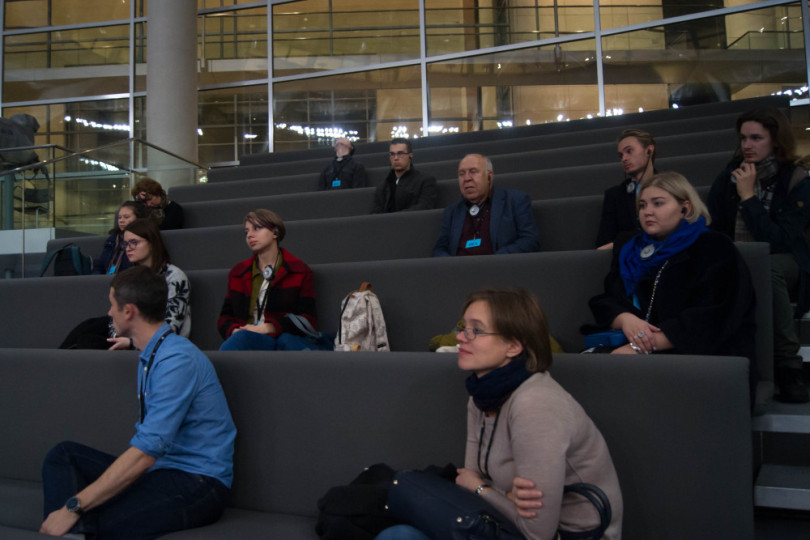
From October 7 - November 12, 2016 a school for undergraduate, graduate and doctoral students organized by the International Centre for the History and Sociology of World War II and Its Consequences was held in Germany. The school was dedicated to issues of memorialization and commemorating victims of terror and was led by the Centre’s Director Oleg Budnitskii. The trip was organized with the support of the Friedrich Ebert Foundation.
This April, Microhistory Days took place at HSE. The event coincided with the visit to the School of History of Prof. Sigurður Gylfi Magnússon (Reykjavík Academy in Iceland) and Dr. István Szijártó (Loránd Eötvös University, Budapest), renowned experts in microhistory, founders of the Microhistory Network, and authors of What is Microhistory? Theory and Practice, a comprehensive analytical monograph.
An international school of young historians, ‘Russian – Polish Entangled History: Scientific Reconstruction and Reflection in the Collective Memory’, took place in April at the School of History (HSE Moscow). Undergraduate and master’s students from HSE and the University of Warsaw took place in the event. Alexander Kamensky, Andrey Iserov, Dariusz Klechowski, Director of the Polish Cultural Centre in Moscow, and Leonid Gorizontov, who lead the organization of the Russian-Polish meeting.
The Director of the HSE Centre for Source Studies presented his research on the role of ‘administrative entrepreneurs’ in the development of early education and other state institutions in Russia under Peter the Great.
The Poletayev Institute for Theoretical and Historical Studies in the Humanities (IGITI) held an international conference on 29-30 October 2015 on ‘Biological Concepts, Models, and Metaphors in Social and Human Sciences’. For two days, Russian, European and American researchers discussed the relations between social sciences and the humanities and various life sciences. This topic arises largely in the light of the recent boom in genetics, medicine and biology which have led academics to reconsider previous concepts of boundaries and connections between disciplines.